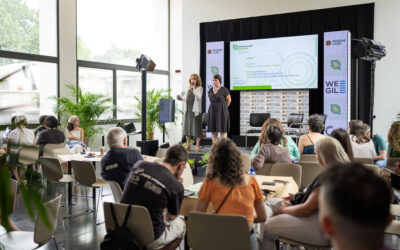
Smile City launches the Urban Living Lab – Faber School, an international co-design and prototyping programme dedicated to the development of innovative and sustainable urban mobility solutions. The initiative is promoted in collaboration with Lazio Innova, through its Spazio Attivo network and regional FabLabs, and aims to actively involve designers, students, researchers, professionals and innovators from across Europe.
At the core of the Urban Living Lab is the challenge of designing an off-grid e-bike charging station, powered by renewable energy and built according to circular economy principles. The infrastructure will be based on prefabricated recycled concrete elements, photovoltaic panels and second-life batteries, and conceived as a modular and replicable solution for European cities. The project is part of the European Horizon programme Smile City – Sustainable Materials for Innovative, Low Emissions Applications in the Circular City, which promotes low-emission, resource-efficient and citizen-oriented urban infrastructures.
The initiative brings together an international ecosystem of partners from research, industry, public authorities and civil society, offering participants the opportunity to work within a real-life innovation environment. Through a co-design and prototyping process, multidisciplinary teams will develop functional and scalable concepts that combine aesthetics, durability, safety and sustainability, while responding to concrete urban needs.
The Urban Living Lab officially started with a first workshop held on 3 December 2025 at the CNR headquarters in Rome and will continue with further sessions hosted by academic and innovation partners, including Sapienza University, Politecnico di Torino and ISIA Faenza. Activities will run through early 2026 and include technical workshops, design reviews, hands-on prototyping and collaborative working sessions within the FabLab network.
Participants will be invited to develop architectural solutions integrating structural systems for photovoltaic panels, secure housing for second-life batteries and additional urban elements such as lighting, seating and information spaces. The programme will conclude with a Demo Day, where teams will present their concepts and prototypes to an international panel of experts.
The call is open to university and ITS students, recent graduates, researchers, designers, makers, technicians, professionals and companies interested in sustainable mobility, renewable energy and circular economy solutions. Selected participants will benefit from visibility within the Smile City project, the opportunity to showcase their work in an international context and, where applicable, reimbursement of travel costs related to project activities.
Applications are open until 10 January 2026. Full details and application procedures are available HERE!