For years, the debate on greenwashing has focused primarily on misleading environmental marketing. Today, however, the discussion has evolved. The real challenge is building a system capable of making sustainability claims credible, measurable and verifiable.
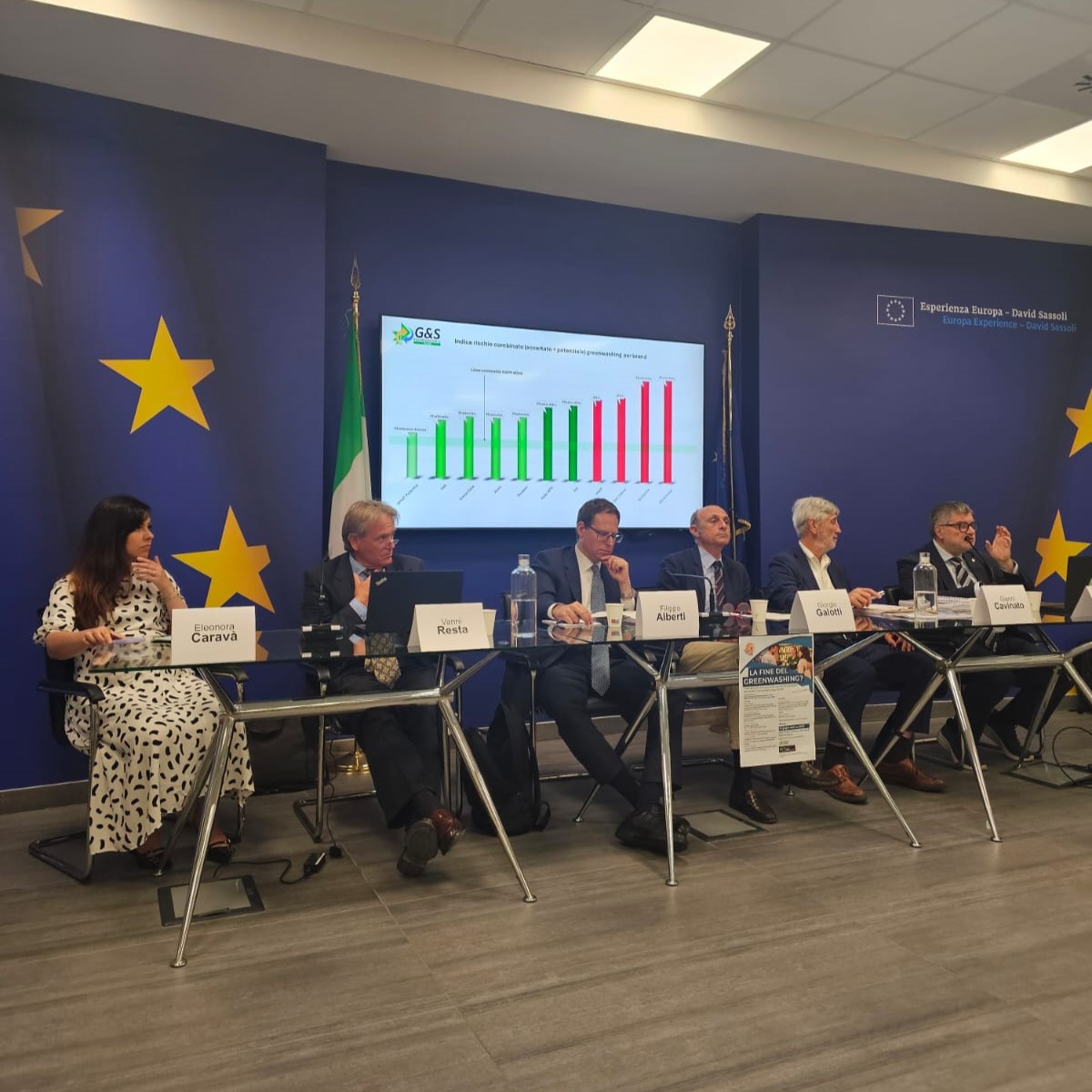
These issues were at the heart of “The End of Greenwashing? How environmental and sustainability communication is changing from Directive (EU) 2024/825 to the Italian Legislative Decree 30/2026”, held at Spazio Europa “David Sassoli” in Rome as part of the European Climate Pact, under the patronage of the European Commission Representation in Italy, the European Parliament Office in Italy and ASviS.
The event brought together representatives of European institutions, legal experts, businesses, consumer organisations and sustainability professionals to discuss how the new regulatory framework will reshape environmental communication and strengthen consumer trust.
A common message emerged throughout the discussion: tackling greenwashing requires more than stricter rules. It demands shared methodologies, robust verification systems and reliable evidence capable of supporting environmental claims.
Within this broader discussion, Fondazione Ecosistemi contributed its experience in sustainable public procurement. Giorgio Galotti, expert in corporate sustainability strategies, highlighted how Green Public Procurement (GPP) already provides a practical example of a system built on verifiable sustainability criteria.
Through Italy’s Minimum Environmental Criteria (CAM), made mandatory under Article 57 of the Public Procurement Code, public authorities do not simply require products and services to meet environmental requirements. They also require suppliers to demonstrate compliance through accredited certifications, documentary evidence, technical verification and life-cycle-based assessment methods.
This experience offers valuable insights for the implementation of the new European framework on environmental claims. The credibility of sustainability communication ultimately depends not only on what companies declare, but on the quality and reliability of the evidence supporting those declarations.
During the event, the main findings of the Greenwashing Report 2023–2026 were also presented, showing that misleading environmental claims remain a significant challenge for both markets and consumers. The report highlights the growing need for robust methodologies capable of distinguishing genuine sustainability performance from unsupported environmental messaging.
Rather than marking the end of greenwashing, the discussion pointed towards the beginning of a new phase. One in which transparency, accountability and verifiable evidence become essential pillars for building trust and supporting the transition towards a more sustainable economy.