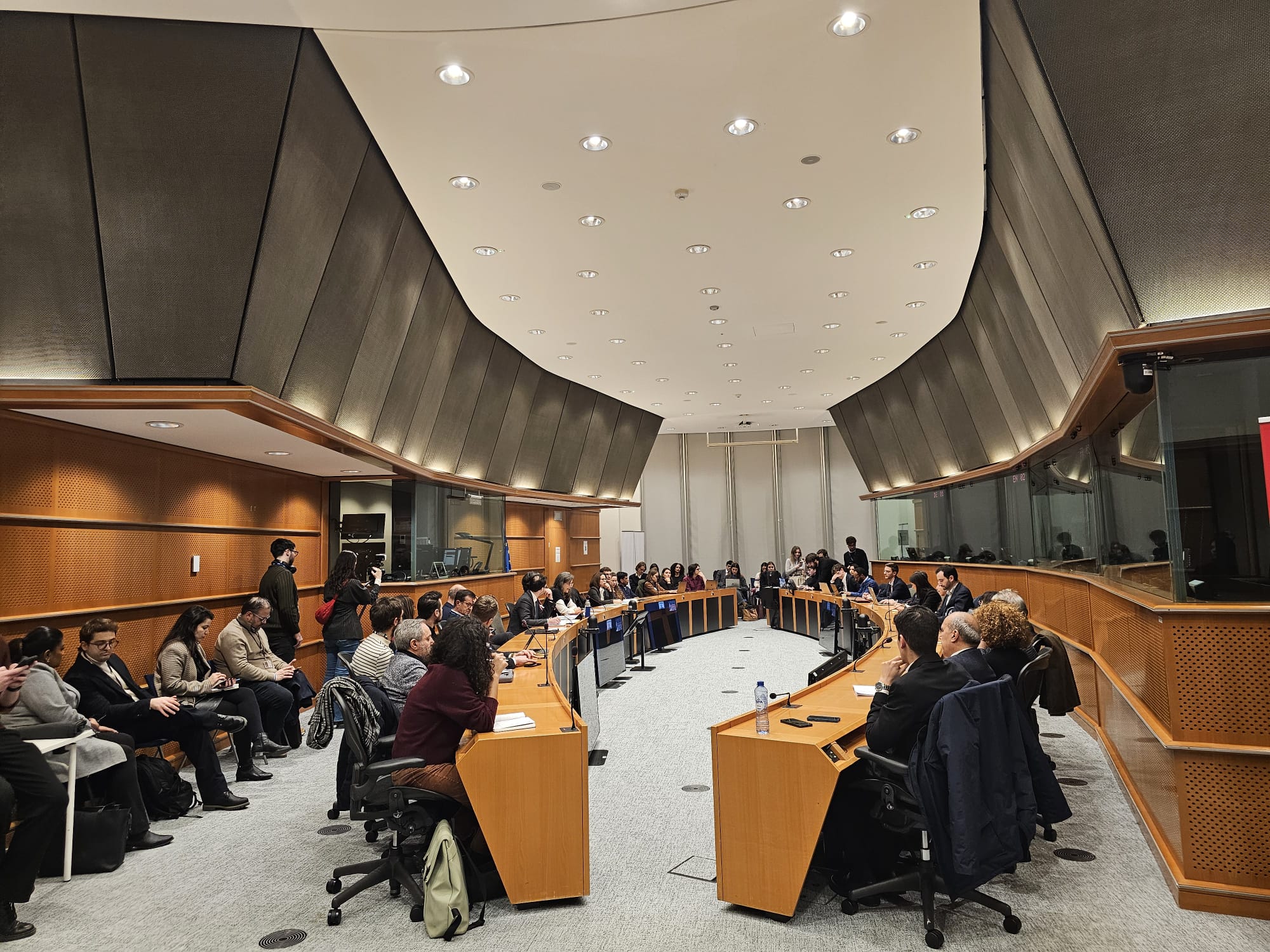
Placing public procurement at the heart of the European agenda as a strategic lever for economic, industrial, environmental and social policy. This was the key message emerging from the event “Buying European and Sustainable is Good Value for Public Money”, held on 13 January at the European Parliament. The initiative was promoted by Fondazione Ecosistemi within the framework of the BESA – Buy European and Sustainable Act campaign, in collaboration with Nicola Zingaretti, Member of the European Parliament and Head of the S&D Italian Delegation.
The discussion focused on Italy’s experience of more than ten years of mandatory Green Public Procurement (GPP) and the implementation of Minimum Environmental Criteria (CAM), presented as a concrete model capable of steering public spending towards decarbonisation, strengthening European industrial value chains and creating quality jobs.
Italy as a European testing ground
Sabina Nicolella, Head of International Relations and Projects at Fondazione Ecosistemi, highlighted how the ongoing reform of EU directives represents “a unique opportunity to strengthen Green Public Procurement across Europe”. Italy, the first EU country to make Minimum Environmental Criteria mandatory, stands out as an advanced case: data show a gradual improvement in the quality of public tenders, increased innovation, and a growing capacity of companies to respond to sustainable public demand.
According to estimates developed within the BESA campaign, the introduction of environmental and European-content criteria in public procurement could generate up to 50,000 new jobs in Italy, reduce emissions by more than 2.2 million tonnes of CO₂ per year, and relocate around €8 billion into sustainable productive activities.
From regions to businesses: evidence from the field
Sessions dedicated to territorial experiences demonstrated the tangible impact of GPP policies. Giulia Tambato (Veneto Region) illustrated the results of ten years of CAM implementation, highlighting increased innovation capacity among companies and the effectiveness of the “most economically advantageous offer” criterion compared to lowest-price approaches.
From Emilia-Romagna, Vincenza Poliandri (Intercent-ER) presented significant figures: over 294,000 tonnes of CO₂ avoided in 2024 alone thanks to green tenders and growing participation by certified companies. She also stressed the need for harmonised European methodologies to measure environmental impacts.
Contributions from business associations showed how sustainable public demand can drive industrial innovation. Matteo Nevi (Assosistema) demonstrated how, in the healthcare sector, the shift to reusable solutions led to CO₂ reductions exceeding 30%, delivering both environmental and economic benefits. Lorenzo Orsenigo (AIS) underlined the link between procurement, sustainable finance and infrastructure, highlighting the role of ESG rating systems in attracting investment.
The European political debate
The political and institutional debate revealed broad consensus on the role of public procurement as a key tool to translate the Green Deal into concrete industrial policies.
For Nicola Zingaretti, S&D MEP and host of the event, “the revision of the Public Procurement Directive is a major opportunity to transform public spending from a purely administrative function into a strategic development lever. The Italian experience shows that clear environmental criteria do not hinder the economy but instead steer markets towards innovation, quality and jobs”.
Annalisa Corrado, S&D MEP and member of the ENVI Committee, stressed the industrial value of green procurement: “Green procurement is, in every respect, a form of industrial strategy. Public administrations can guide investment towards environmental and social sustainability while tackling unfair competition by rewarding quality. It is a win-win-win situation: for the climate, for forward-looking companies and for society. It has worked in Italy and should now become a European pillar, especially at a time when corporate social responsibility risks being weakened.”
From an internal market perspective, Pierfrancesco Maran, S&D MEP and member of the IMCO Committee, noted that “the revision of procurement rules must provide clear and predictable frameworks, capable of supporting companies through the transition and strengthening European competitiveness without undermining environmental objectives”.
A strong political message also came from Gabriele Bischoff, Vice-President of the S&D Group, who reaffirmed “the need to defend the Green Deal as a cornerstone of the European project, ensuring coherence between industrial, climate and social policies through concrete instruments such as public procurement”.
From the Conservative side, Stefano Cavedagna, ECR MEP, emphasised “the importance of avoiding excessive rigidity, while maintaining the goal of making procurement an effective tool to support innovation, competitiveness and European value chains”.
Completing the institutional picture, Henning Ehrenstein, Head of Unit at the European Commission (DG GROW), recalled that “the revision of the Public Procurement Directive aims to make public spending more strategic, integrating environmental and industrial criteria in a way that is consistent with the internal market and the EU’s climate objectives”.
From the Italian experience to European reform
The debate confirmed that Italy, as the first European country to make Minimum Environmental Criteria mandatory, can play a leading role in the European discussion by providing evidence, data and concrete case studies to support an ambitious reform of the Public Procurement Directive.
The 13 January event represents a strategic milestone in the lead-up to the 20th edition of the Forum Compraverde Buygreen (May 2026) and within the advocacy work of the BESA campaign, aimed at transforming European public spending into a stable instrument of industrial, climate and social policy.
The event was livestreamed on YouTube.