On International School Meals Day 2026, SchoolFood4Change proudly unveils Green Spoon – Good Food for Planet and Community, a new European and easy-to-use online tool designed to measure the environmental and health impact of school meals.
At a time when food systems are gaining increased attention for their potential to address climate change, biodiversity protection and public health, the Green Spoon tool offers a concrete solution cities have long needed: a way to translate sustainability ambitions into measurable outcomes.
Food systems are responsible for nearly one third of global greenhouse gas emissions. They also drive land-use change, water stress and ecosystem degradation. Yet school meal programmes — which feed millions of children every day — represent a unique opportunity to reshape demand, support sustainable agriculture and promote healthier diets.
Across Europe, cities participating in SchoolFood4Change (SF4C) have been working to redesign food procurement criteria, increase plant-based menus and adopt a Whole School Approach to Food. However, while policy commitments have grown stronger, measuring real progress has remained complex.
Green Spoon was developed by Fondazione Ecosistemi in collaboration with cities from the SF4C network to fill this gap. The tool helps local government employees, policymakers, food policy council members and procurement experts assess how school meals affect climate, land use and health — all within a single system.

What Makes Green Spoon Different
Unlike conventional carbon calculators, Green Spoon does not limit its analysis to the last 20 years of land use change for greenhouse gas emissions. Its methodology follows instead the World Resources Institute approach, by incorporating the Carbon Opportunity Cost, a more advanced way of evaluating land use impacts, considering the difference between natural ecosystems and agricultural production. This approach captures the true climate pressure associated with food production, particularly for land-intensive products.
The tool also distinguishes between agricultural systems such as organic farming, natural pasture systems, agroforestry and sustainable fisheries. It highlights the environmental benefits of plant-based menus and integrates food waste into its emissions assessment.
Crucially, Green Spoon connects environmental data with nutritional indicators. It evaluates protein balance, fruit and vegetable intake, the presence of ultra-processed foods and overall dietary quality. By doing so, it reflects the understanding that climate action and public health cannot be addressed separately. The result is a systemic tool that mirrors the complexity of food systems themselves.
How It Works
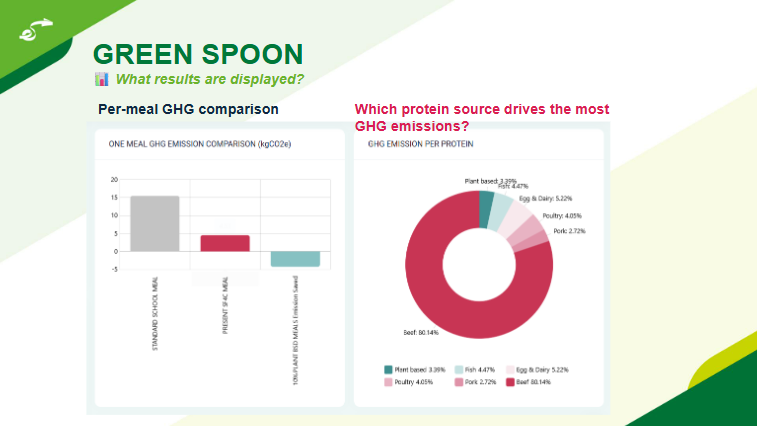
Green Spoon is designed to be accessible for municipalities, procurement officers and school meal providers. Users can input menu data, annual procurement quantities or structured datasets. Based on the given input, the tool generates environmental and health indicators, including greenhouse gas emissions, comparisons between standard and more sustainable meal models, and insights into the effects of increasing plant-based options. It also supports data collection for Social Return on Investment (SROI), helping public authorities understand the broader societal value of investing in sustainable school food.
Co-Designed and Tested Across Europe
Throughout its development, methodological transparency and usability have been key priorities. Green Spoon is the result of a collaborative co-design process involving more than 20 cities and regions across Europe. Within the SchoolFood4Change network — which brings together 43 partners in 22 countries — several municipalities tested the tool and its applicability in real-life school meal settings.
Their feedback helped Fondazione Ecosistemi refine the tool’s functionalities to ensure it responds to practical challenges in public procurement and catering management. The outcome is a scientifically robust yet adaptable instrument that can function in diverse food system contexts. While initially developed for schools, Green Spoon can also be applied to other public catering environments, including hospitals, universities and corporate canteens.
Good Food for Planet and Community
The name Green Spoon reflects a broader vision of food as a shared responsibility. School meals are not only about feeding children — they are about shaping food cultures, strengthening local economies and contributing to Europe’s climate goals.
By making impacts measurable, Green Spoon empowers cities to move from aspiration to implementation. It turns sustainability commitments into data-driven decisions and supports a transition towards healthier, more resilient public food systems. On International School Meals Day, Green Spoon stands as a concrete example of how European collaboration can transform public procurement into a driver of systemic change.
Discover the tool here: https://greenspoondata.eu/