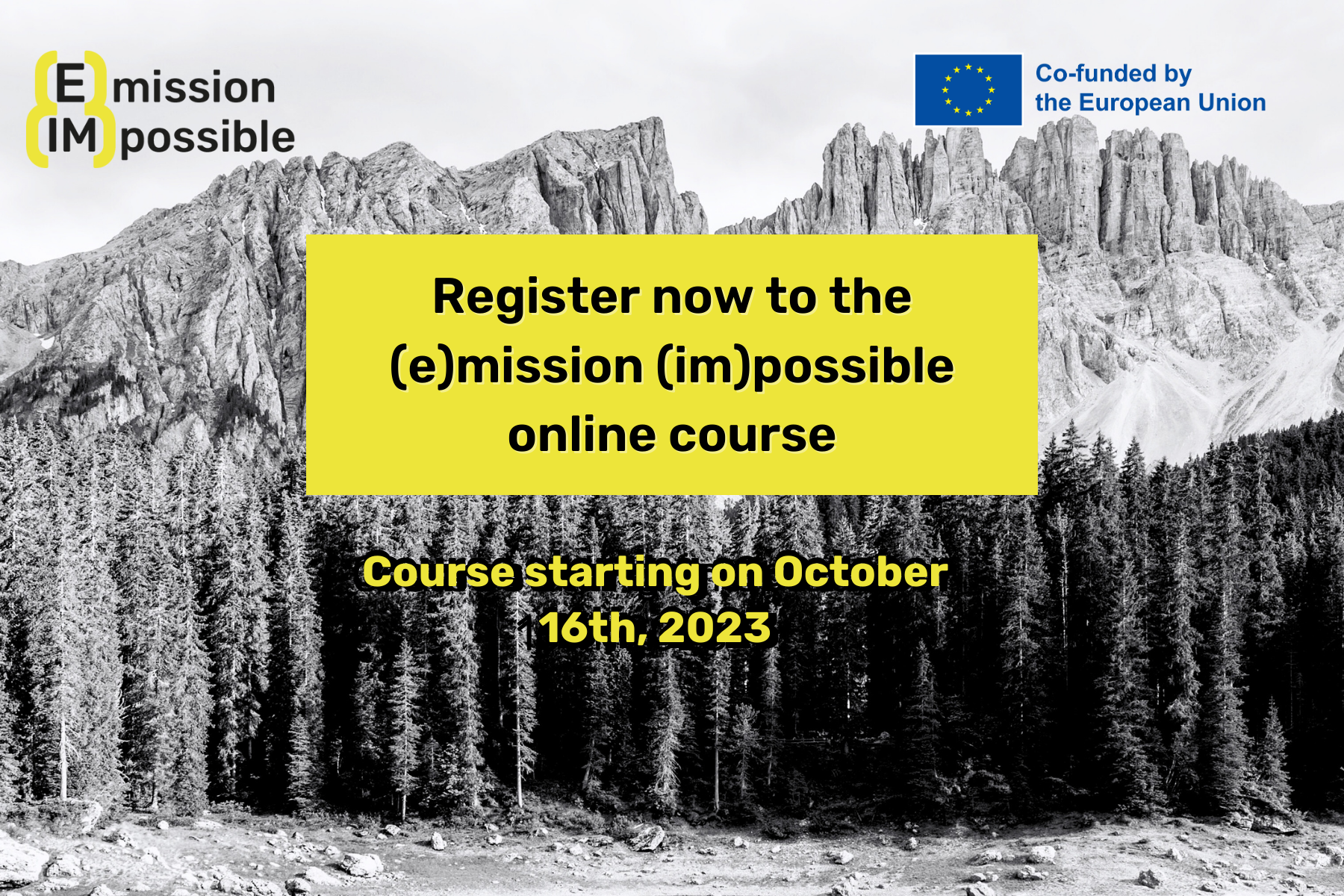
We have had a successful first version of our open access online course of (e)mission (im)possible! Thanks to the feedback received, we are launching a new, refined version of the course on the 16th of October, 2023. The course will be open for 2 months, until the 16th of december 2023.
Did you miss the chance to complete the course before? Are you getting to know our course and what we do only now? Do you want to learn how to integrate climate action into the development, cooperation and humanitarian aid sectors?
What we offer
If you answered yes in one of these questions, this course is what you’re looking for! It is completely free of charge, co-funded by the European Union and organized and directed by six organizations in Italy (A Sud, Un Ponte Per, Fondazione Ecosistemi), Spain (Iroko, Bosque y Comunidad) and Portugal (AIDGLOBAL) and the University of Cadiz, Spain.
The course is divided into 4 different modules. It takes about 25 hours of total work, split into short video lessons, integratory readings and tests to assess your acquired knowledge on the course material. You can access any lesson and material at all times during the course period.
Upon completion of the course (you must get at least 50% of correct answers on all tests), and after the course ends on the 16th of December 2023, you will receive a certificate and 1 ECTS credit from the University of Cadiz.
Why the (E)mission (Im)possible course
We are a group organizations that work in climate, It is completely free of charge, co-funded by the European Union and organized and directed by six organizations , cooperation, reforestation, and development and we came together to understand how to integrate actions to reduce climate-altering emissions. Our goal is to improve a sector that is already working towards positive change and has a great potential to address issues in a sustainable and less impactful way.
Climate change is primarily affecting the most vulnerable populations. Thus, we feel it is necessary to link the work undertaken to support communities and territories to that of a climate commitment in cooperation and development.
Climate migrations, natural disasters, and extreme weather events can all be linked to anthropogenic climate change (caused by human activities, unlike the “natural” one, characterized by a long natural cycle of change). Therefore, by addressing climate change, we also act on mitigating the effects and consequences, contributing to the specific work brought out by the development sector.
Furthermore, each third sector organization has an impact on the environment and climate given by procurement, travel, energy and policies: how can someone who works or aims to work in this sector commit to include climate action into their daily work? And what about getting funding and recounting what we do? Can these aspects of our work be less impactful on our vulnerable climate?
Through the (e)mission (im)possible project, we try to give some inputs on solutions and practices, as well as tools and information about all of these aspects. If you are interested in the topic and want to know more, register for the course from today and access the learning platform, starting on the 16th.