Call To Action! Online course pre-registrations are now open!

28 July 2022

The online course is free and offers to development, cooperation and humanitarian aid sector professionals, volunteers students and teachers a 25 hours long training course, which can be certified with ECTS credits.

Created by professionals of the development and cooperation sector with experts on environmental and climate accounting, the MOOC was designed to be attended in a flexible and compatible way with professional and study activities of participants.

Available in English, Italian, French, Spanish and Portuguese, the course seeks to provide a vision, as well as essential knowledge, methodological and techical tools, to orient a transformative process aimed at reducing emissions in the sector and promoting positive climate actions.

Divided into 6 hours of short video lectures and 19 hours of further study materials and tests, the course’s goal is to develop competences in 4 key thematic clusters:

  • Climate change basics: climate science and international governance

  • The human dimension of climate change: liabilities, climate justice and human rights

  • Organisations’ actions to curb emissions and to improve their climate action

  • Engage others in change: getting donors, partners, local communities and decision makers on board


See the full programme here.

Are you interested? You can pre-register by filling this form.

The start of the course is scheduled to start in mid- October, 2022.
News

EU public procurement: geographic origin or green criteria? A key issue in the European debate

EU public procurement: geographic origin or green criteria? A key issue in the European debate

The European debate on public procurement is moving beyond slogans and into substance. The core question is no longer simply how to support European industry, but which principle should guide public spending: geographic preference or environmental performance. An article published by EconomiaCircolare.com highlights the position of the European Environmental Bureau (EEB), set out in its paper “Made with EU Green Criteria. Why ‘Buying Sustainable’ can future-proof EU industry.” According to the EEB, prioritising “Buy European” purely on the basis of origin may not be sufficient. The real issue is not where products are made, but how they are made and which environmental and social standards they meet.

read more
Forum Compraverde Buygreen 2026: the 20th edition of the General Assembly on Green Procurement will be held in Rome on 27 and 28 May

Forum Compraverde Buygreen 2026: the 20th edition of the General Assembly on Green Procurement will be held in Rome on 27 and 28 May

On 27 and 28 May 2026, Forum Compraverde Buygreen returns to Rome at WeGil. It is the leading national and European event dedicated to Green Public Procurement (GPP) and sustainable purchasing policies, promoted by Fondazione Ecosistemi. The 2026 edition marks both a symbolic and substantive milestone: the 20th edition of the States General of Green Public Procurement, taking place at a crucial moment for Europe, as the revision of the EU Public Procurement Directive and the reshaping of European industrial and climate policies are underway. The 2026 concept translates into two days, twenty thematic events and twenty concrete solutions: an operational atlas of the transition, not simply a conference programme.

read more
Public procurement and the Green Deal: from Italy to Brussels, a debate on the future of European policies

Public procurement and the Green Deal: from Italy to Brussels, a debate on the future of European policies

Public procurement as a strategic lever for the European Green Deal.
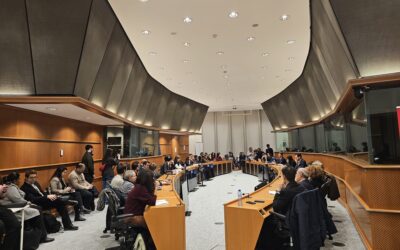
On 13 January at the European Parliament, the event “Buying European and Sustainable is Good Value for Public Money” brought Italy’s more than ten years of mandatory Green Public Procurement experience to Brussels. Promoted by Fondazione Ecosistemi as part of the BESA – Buy European and Sustainable Act campaign, in cooperation with MEP Nicola Zingaretti (S&D Group), the event brought together European institutions, policymakers, businesses and civil society to discuss the role of public spending in driving the ecological transition, strengthening European industrial value chains and creating quality jobs, ahead of the revision of the EU Public Procurement Directive.

read more