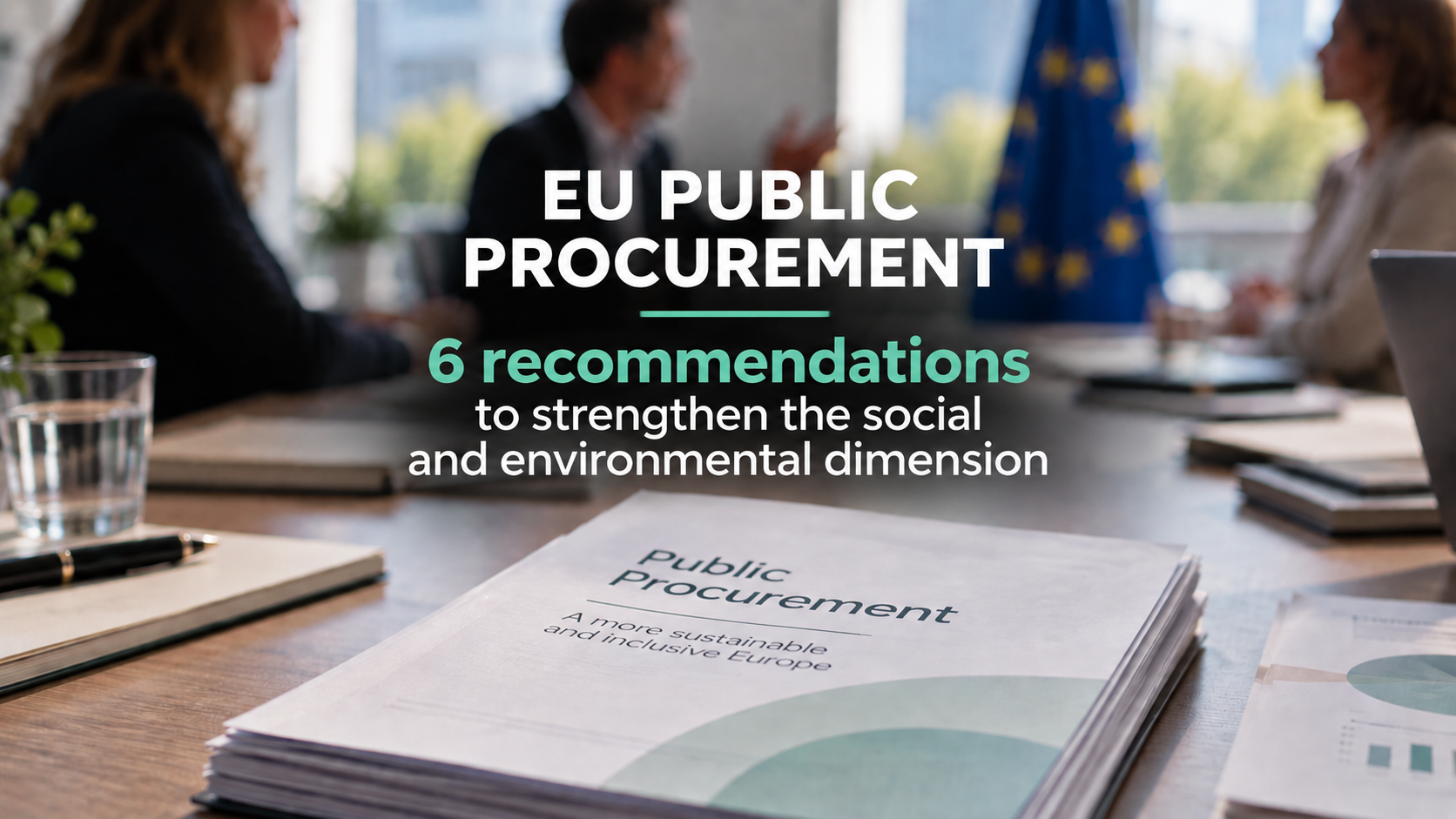
The International Working Group on Ethical Public Procurement (IWGEPP) has issued six recommendations on the European Commission’s proposed Public Procurement Act, calling for stronger human rights protections, environmental sustainability and transparency across public procurement supply chains.
The International Working Group on Ethical Public Procurement (IWGEPP) has put forward six recommendations to strengthen the social and environmental dimension of the EU’s proposed Public Procurement Act. Fondazione Ecosistemi contributed to the development of the recommendations.
The working group welcomes several improvements in the Commission’s proposal, including the move away from lowest price as the predominant award criterion, greater recognition of working conditions in global supply chains, increased supply chain transparency and the monitoring of social and environmental outcomes. However, it also identifies areas where further action is needed to ensure that public procurement more effectively protects human rights and the environment.
The IWGEPP’s Six Recommendations
The first recommendation concerns the Best-Price-Quality Ratio (BPQR). While the IWGEPP welcomes the shift away from lowest-price procurement, it argues that the proposed minimum weighting of 30% for quality criteria risks leaving social and environmental considerations with only a marginal role. The group therefore calls for these criteria to be given meaningful weight, proportionate to the human rights and environmental risks associated with the goods, services or works being procured.
The second recommendation is to explicitly integrate Human Rights and Environmental Due Diligence (HREDD) into award criteria and contract performance conditions. This would help ensure that suppliers identify, prevent, mitigate and address adverse human rights and environmental impacts throughout their supply chains.
The statement also calls for public procurement to support the effective implementation of the Corporate Sustainability Due Diligence Directive (CSDDD) by providing a clear legal basis for considering compliance with due diligence obligations and applying risk-based due diligence requirements.
A fourth recommendation concerns the link to the subject matter of the contract. According to the IWGEPP, greater legal clarity is needed to allow contracting authorities to consider suppliers’ human rights and environmental policies, codes of conduct and supply chain risk management strategies when these are relevant to the performance of a specific contract.
The fifth recommendation focuses on increasing supply chain transparency. Contracting authorities should have proportionate, risk-based access to information on working conditions at production sites, impacts on affected communities and suppliers’ due diligence processes.
Finally, the group calls for EU-level guidance and model contract clauses on due diligence, providing contracting authorities with practical tools to translate social and environmental objectives into procurement procedures.
An International Network for Responsible Procurement
Established in 2011, the IWGEPP brings together representatives from more than 45 organisations across several countries, including public bodies, procurement and sustainability professionals, policymakers, academics, NGOs, trade unions and civil society organisations. The network promotes the integration of socially responsible procurement into purchasing processes and facilitates the exchange of good practices and practical tools.
Its recommendations address a central challenge of the proposed reform: translating social and environmental objectives into award criteria, contract conditions and practical tools that contracting authorities can effectively apply, strengthening the role of public procurement in promoting more responsible supply chains.