In 2024, the Italian public administration spent over €272 billion on public procurement—a huge economic and strategic lever that, if well-directed, can drive the country’s ecological transition. But how effectively are Italian municipalities using Green Public Procurement (GPP) to purchase goods and services in an environmentally responsible way?
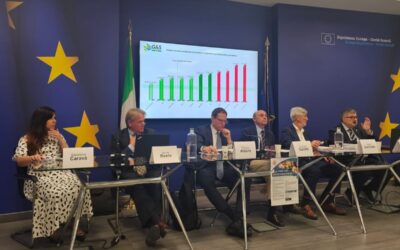
The second part of the VIII Green Public Procurement Observatory Report, promoted by Legambiente and Fondazione Ecosistemi, provides the answer. It was presented today in Rome during the XII Ecoforum on Circular Economy.
Following the first part of the report—which focused on regional procurement centers, local health authorities (ASL), protected areas, and metropolitan cities (with an average GPP index of 71%) and was presented last May at the Forum Compraverde Buygreen—the new analysis examines 585 municipalities (538 non-provincial capitals and 47 provincial capitals), offering the first national civic survey on the application of Minimum Environmental Criteria (CAM) in 2024 public tenders.
Key Figures: Between Legal Obligation and Practical Implementation
The national average GPP performance stands at 56%, considering the application of CAM and sustainability-supporting policies in procurement. The average rises to 75% in provincial capitals but drops to 55% in non-capital municipalities, highlighting the significant role of administrative structure in implementation capacity.
Small municipalities dominate the sample, with 58% having fewer than 5,000 residents. These are also where delays are most evident, with lower performance and structural gaps in training, governance, and monitoring tools.
“Adopting Green Public Procurement through conscious choices in goods and services is a strategic lever to promote ecological transition in cities and steer public policies toward sustainability,” emphasizes Andrea Minutolo, scientific director at Legambiente. “This is why, within the Ecoforum, we decided to award two special mentions this year to municipalities that stood out for their effective application of CAM and GPP.”
Best Practices: Leading Provincial Capitals and Small Municipalities
Two special mentions were awarded in 2025:
-
Cesena, as the best provincial capital (100% GPP)
-
Bareggio (MI), as the best non-capital municipality (95% GPP)
Among provincial capitals, Padua and Milan also achieved 100% GPP, while Rome, Cremona, and Ravenna reached 95%. All six appointed a dedicated GPP officer, a key factor for achieving tangible results.
Even smaller municipalities show good practices: Celle Ligure (SV), Bareggio (MI), Arcidosso (GR), and Merano (BZ). The first two appointed a green procurement officer, demonstrating that governance matters, even in small towns.
Critical Issues: Training, Monitoring, and Weak Structures
Despite the mandatory nature of CAM under Article 57 of the new Public Procurement Code (D.lgs. 36/2023), the national picture reveals delays and systemic gaps:
-
Only 5% of municipalities monitor green purchases (21% among provincial capitals)
-
Only 4% have appointed a GPP officer (rising to 9% in capitals)
-
GPP training is present in just 32% of administrations, even though 69% of municipalities identify it as a priority gap
In many cases, GPP is known but not yet implemented systematically. Social criteria and gender-responsive procurement, for instance, are applied in 83% of capitals, but only in 51% and 33% of non-capital municipalities, respectively.
A Strategic Lever (Still) Underutilized
Green Public Procurement is not optional—it is a key strategy connecting the circular economy, industrial innovation, and environmental justice. Yet its implementation remains uneven.
“GPP must become a model of responsible administration,” comments Silvano Falocco, director of Fondazione Ecosistemi. “It can transform public spending into a tool for sustainable development. Where applied with vision, GPP works: now we need to extend these best practices across the entire country.”
The VIII Green Public Procurement Observatory Report is available online at www.appaltiverdi.net.