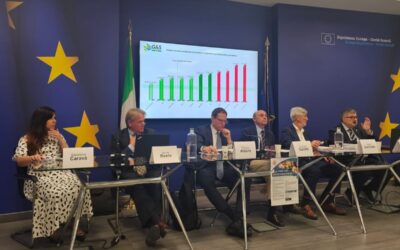
MIRA Network and ECCO think tank, together with ten organisations and networks – Kyoto Club, Legambiente, Fondazione Ecosistemi, Transport & Environment, WWF Italia, Coordinamento FREE, ActionAid, Forum Diseguaglianze e Diversità, Concord Italia e Laudato Sì Movement have presented a joint document outlining observations and recommendations on the next EU budget, the Multiannual Financial Framework (MFF) 2028–2034.
The MFF sets the EU’s spending priorities for a seven-year period and defines the resources available to achieve them. The proposal presented by the European Commission on 16 July 2025 foresees a total budget of €2 trillion (equivalent to 1.26% of the EU’s Gross National Income), structured around three main pillars: National and Regional Partnership Plans (€865 billion), the European Competitiveness Fund (over €500 billion), and the new Global Europe instrument for external action (€200 billion).
This proposal represents a significant shift in the architecture of the EU budget. Existing funding programmes under the current MFF would be consolidated into a smaller number of broad intervention lines, with the stated aim of increasing flexibility, simplicity and effectiveness, but at the cost of a more centralised governance model, similar to the Recovery and Resilience Facility.
Following the presentation of the proposal last July, negotiations between EU institutions have now entered a decisive phase. With the Cypriot Presidency of the Council accelerating the process of defining Member States’ positions, Italy is expected to develop its national stance as soon as possible. Intensive work is underway among the relevant ministries – particularly the Ministry of Economy and Finance – and the Italian Representation in Brussels. The first key institutional milestone is already scheduled: the European Council on 19–20 March, where the MFF will be a central topic of discussion among EU heads of state and government.
Italy is among the main beneficiaries of EU funds and the country that has received the largest share of support through the Recovery and Resilience Facility. The next MFF is largely inspired by that model, with significant implications for long-standing instruments such as cohesion policy and the European Social Fund, as well as for territorial projects that depend on these resources.
As Italian civil society, we have chosen to actively contribute to this process. The document we present is intended as a concrete contribution to shaping Italy’s position, based on the conviction that an effective and fair EU budget cannot be designed without the involvement of those working daily with the real needs of communities. We therefore call on policymakers to engage with civil society and bring our proposals into the negotiation process. In several European countries – including Poland, the Czech Republic and Slovakia – civil society is already part of these discussions. With these recommendations, we aim to do the same.
Our recommendations focus on seven priority areas, on which we call on the Italian government to take a clear position in EU negotiations. From governance of funds to the protection of workers most exposed to the climate transition, from environmental targets to international cooperation, the decisions taken at this stage will shape European policies and investments for an entire generation.
In summary:
- Governance and participation
Introduce binding criteria to ensure effective participation of regions, local authorities and stakeholders in the design and monitoring of EU funds. This includes structured and regular consultations, as well as public reporting mechanisms on programme implementation, in order to promote a more transparent, participatory and impact-oriented approach. In this perspective, it is essential to strengthen the partnership principle and its monitoring tools, such as monitoring committees. - Just transition and cohesion
Restore the Just Transition Fund (JTF) as a standalone instrument within the MFF, with adequate financial resources targeted primarily at regions most affected by the climate and industrial transition. Continuity of support for territories already benefiting from the fund must also be ensured. If reintroducing the JTF as a dedicated fund is not possible, a horizontal spending target for just transition should be introduced within the MFF. - Climate and biodiversity
Strengthen green spending targets by increasing the climate and environmental target to 50% and restoring a dedicated 10% biodiversity target, without lowering the current minimum threshold of 35%. The target should apply to the entire MFF budget, including defence and security expenditure, and positive climate and environmental coefficients should be assigned only to investments with proven environmental impact. - “Do no significant harm” principle
Ensure consistent application of the DNSH principle across all MFF funds, excluding projects recognised as harmful to climate and the environment. Exceptions should be strictly limited. A sector-specific approach and an effective ex post monitoring system are also recommended. - LIFE Programme
Reinstate the LIFE Programme as a standalone funding instrument, with its own regulation, dedicated budget and direct management by the European Commission, in order to continue supporting targeted projects on environmental protection, biodiversity and climate action. - Social dimension
Strengthen the social dimension of the MFF by restoring the European Social Fund Plus (ESF+) or, alternatively, reintroducing dedicated allocations for social inclusion and poverty reduction. In any case, a minimum social spending target of at least 14% should be maintained, and access to EU funds should be conditional on compliance with social standards, including labour rights, fair wages, collective bargaining and non-discrimination. - External action
Ensure that the new Global Europe instrument maintains a clear focus on poverty reduction and sustainable development, in line with EU commitments in international cooperation. Adequate funding levels for external action must be preserved, with resources directed towards key priorities such as human development, gender equality, climate and biodiversity. At the same time, funding predictability should be ensured, the role of civil society in programming strengthened, and development cooperation funds should not be made conditional on migration management objectives.
The full document, including a detailed analysis of the Commission’s proposal and comprehensive recommendations, is available HERE.